

Last updated: November 21, 2026
Quick Answer
Search engines detect CTR manipulation via residential proxies by analyzing behavior patterns across sessions, not just IP addresses. Google combines session-level behavioral classifiers, IP cluster analysis, device fingerprinting, and graph-based network detection to spot clicks that look human on the surface but behave like a script underneath. Penalties range from ranking demotion lasting up to two years to full deindexing, and in 2026 detection windows have shrunk from weeks to days [1].
Key Takeaways
- Residential proxies hide the IP but not the behavior pattern behind the click [2][3].
- Google filtered 5.15 trillion invalid interactions in 2026 alone through automated systems [4].
- Session-level classifiers launched in Q1 2026 track behavior across multiple queries, not single clicks [1].
- Penalties include ranking demotion for up to two years or complete site bans [1].
- Residential proxies differ from datacenter proxies mainly in IP reputation, not in detectability [1][3].
- Graph-based systems like Google's Spanner Graph connect proxies, accounts, and identities to expose fraud networks [4].
- The effective lifespan of a CTR manipulation campaign has dropped 30-50% since late 2025 [1].
- Legitimate SEO growth through content and search intent work remains the safer, durable path.
What Are Residential Proxies and Why Do People Use Them for CTR Manipulation
Residential proxies are IP addresses tied to real home internet connections, rented out to multiple customers at once. People use them for CTR manipulation because a residential IP looks far more trustworthy to a search engine than a datacenter IP, which is an easy giveaway of automated traffic.
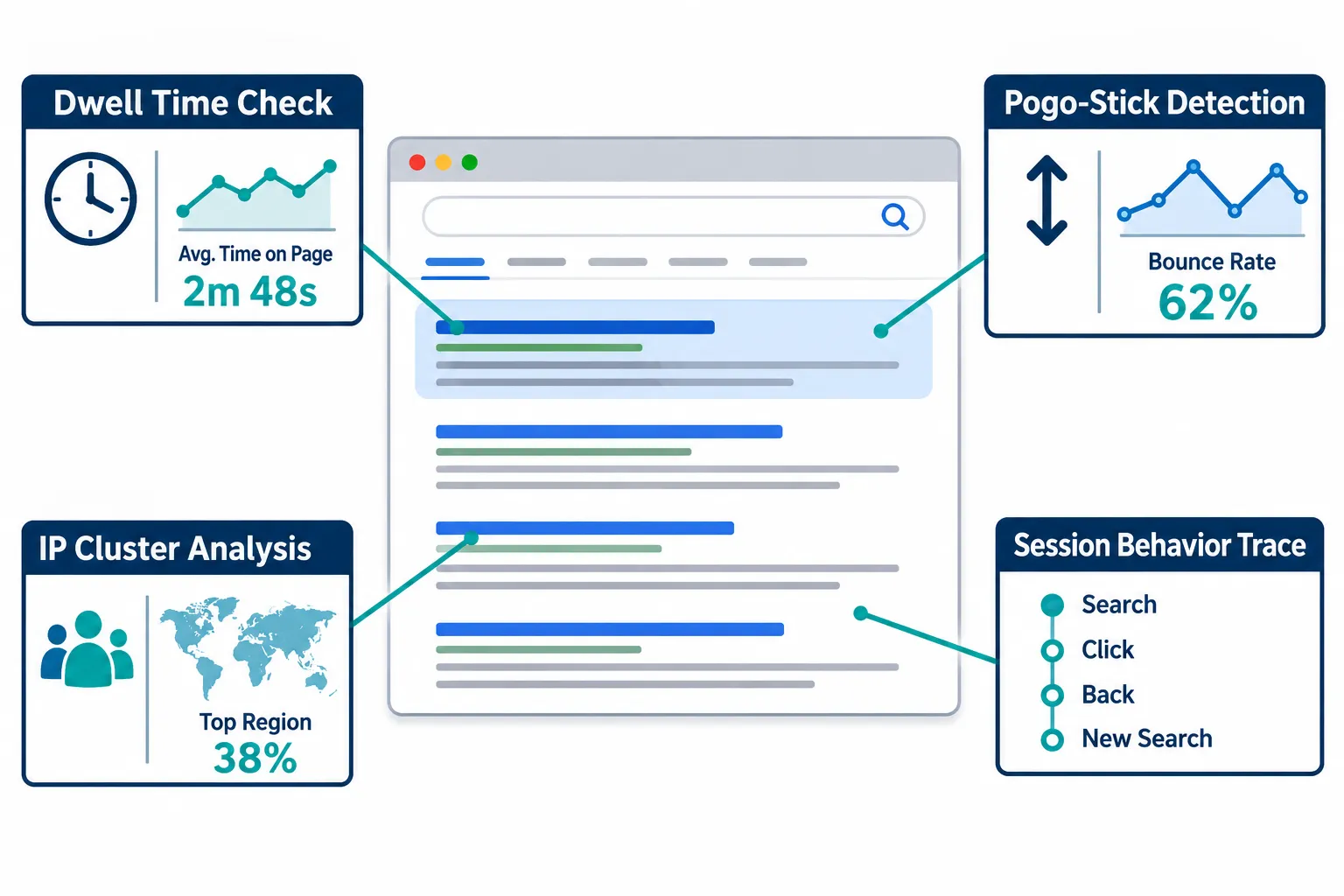
The idea behind this black-hat tactic is simple on paper. Someone runs a script that searches a keyword, scrolls down, and clicks a specific result, hoping to fake a higher click-through rate and nudge rankings upward. Doing this from a data center IP gets flagged almost instantly, so operators route the traffic through residential proxy networks to borrow the trust of a real home connection.
The problem is that renting a proxy doesn't rent a real person's browsing history, habits, or device fingerprint. Browsers behind these proxies are often freshly created or reused across many "different" sessions, and that gap is exactly what search engines exploit [2].
How Exactly Do Search Engines Detect Fake Clicks From Residential Proxies
Search engines detect fake clicks from residential proxies by layering several detection systems: IP cluster analysis, browser fingerprinting, dwell-time ratios, and session-level behavioral classifiers that track a user across multiple searches, not just one click [1][3].
Here's what typically gets flagged:
- IP cluster analysis, if hundreds of "different" users share patterns tied to the same proxy pool, that pool gets a reputation flag [3].
- Dwell-time ratios, a click followed by an instant bounce, repeated thousands of times, doesn't match how real users read a page [1].
- Device and browser fingerprint mismatches, unusual mixes of user-agents, screen sizes, and automation traits like WebDriver signatures [3].
- CTR spikes without impression growth, a sudden jump in clicks with no matching rise in how often the page even appears in search results [3].
- Unnatural time distribution, clicks arriving evenly around the clock instead of following normal human search behavior [3].
Google's November 2026 ad safety update confirms this isn't theoretical. The company reports working with law enforcement and industry partners specifically to dismantle "botnets and residential proxy networks" used for fraud [4].
What's the Difference Between Residential Proxies and Datacenter Proxies for Click Fraud
The core difference is IP reputation, not actual traffic legitimacy. Datacenter proxies are flagged almost instantly because their IP ranges are publicly known to belong to hosting companies, while residential proxies borrow home-network IP addresses and take longer to flag, but they still get caught [1][3].
Choose neither if your goal is sustainable rankings. Both routes end up in the same place eventually: a flagged pattern, a demoted page, and wasted money.
Can Google Tell the Difference Between Real Clicks and Proxy-Generated Clicks
Yes, increasingly well. Google's systems don't rely on IP address alone anymore; they combine behavioral signals across an entire session to separate real human curiosity from scripted click patterns [1][4].
A real click usually comes with messy, inconsistent behavior: a user searches, clicks one result, goes back, refines the query, clicks another result, maybe opens a new tab. A bot behind a residential proxy tends to do one clean thing over and over: search, click, leave. That uniformity is the giveaway [2].
Google's Spanner Graph system, announced in November 2026, goes a step further by linking location proxies, account signals, and identity parameters that look harmless alone but expose a coordinated network when mapped together [4]. This means even spreading clicks across thousands of "different" residential IPs doesn't fully hide the pattern anymore.
What Are the Penalties You Get If Google Catches You Manipulating CTR
Penalties for CTR manipulation range from algorithmic ranking demotion to a full site ban, and Google's own ads policies explicitly classify artificially inflating clicks or impressions as a spam violation [1][3].
Industry guidance puts the demotion period at up to two years in serious cases, with complete bans reserved for repeat or egregious offenders [1]. In the past year alone, Google took enforcement action against more than 245,000 publisher sites for policy violations, including click inflation [4]. This isn't a small side effect; it's an active enforcement priority.
Common mistake: assuming a short-term CTR boost is worth the risk because "Google won't notice a small site." Scale doesn't protect you here. Detection systems flag patterns, not just big-name domains.
Can You Get Completely Deindexed From Google for CTR Manipulation
Yes, deindexing is possible in severe or repeated cases of CTR manipulation, though it typically follows a pattern of warnings, ranking drops, and manual review before a full ban is applied [1][3].
Deindexing means your pages disappear from search results entirely, not just drop a few positions. For a business relying on organic traffic, this is close to a worst-case scenario. Recovery, if even possible, takes months and requires proving the manipulative behavior has stopped completely.
Edge case: sites using third-party traffic services sometimes get penalized without the owner's direct knowledge, if a freelancer or agency quietly ran a CTR bot campaign in the background. This is one more reason to vet any vendor claiming to "boost rankings fast."
What Behavioral Signals Do Search Engines Look for Beyond Just IP Addresses
Beyond IP addresses, search engines examine dwell time, click sequencing, query refinement patterns, device fingerprints, and session-level consistency to judge whether a click came from a real, curious human or a scripted agent [3].
Key behavioral signals include:
- Natural search refinement (real users often tweak their query after the first result disappoints them)
- Variation in time-on-page across different clicks
- Scroll depth and mouse movement irregularities
- Return visits from the same device over time, which bots rarely replicate
- Cross-session consistency tied to a real identity, not a disposable browser profile
A 2026 detection guide adds that "too perfect" interaction patterns, clicks that behave with suspicious consistency, are now a direct red flag in themselves [3]. Real humans are messy. Bots, even good ones, tend to be too clean.
What Are the Most Common Mistakes People Make With Residential Proxy Click Schemes
The most common mistake is reusing the same proxy pool or script logic across many "different" sessions, which creates a detectable fingerprint cluster even when IPs rotate [1][3].
Other frequent mistakes:
- Running clicks in unnatural volume spikes that don't match impression growth [3]
- Skipping query variation, so every click comes from an identical search phrase
- Ignoring device diversity, leaving consistent screen resolutions or browser versions across sessions
- Running campaigns around the clock instead of matching natural human search hours
- Assuming residential IPs are a permanent shield, when they're really just a speed bump
Choose to avoid this entirely if you're managing a client's site or your own brand, because the downside (ranking demotion, lost trust, wasted budget) far outweighs any short-term gain.
Is CTR Manipulation With Proxies Even Worth the Risk Anymore
No, it's not worth the risk in 2026. Detection windows have tightened from weeks to days, and the financial and ranking downside of getting caught is steep compared to the diminishing upside of a temporary CTR boost [1].
Here's the practical math: residential proxy services aren't free, click volume needed to move rankings meaningfully keeps rising as detection improves, and the benefit window keeps shrinking. Analysts tracking SERP manipulation report a 30-50% reduction in sustained effect duration in 2026 compared to late 2025 [1]. You're paying more for less, with a bigger downside risk attached.
If you want to understand how this fits into the bigger picture of black-hat tactics and why they keep failing long-term, this breakdown of black hat SEO and CTR manipulation covers the mechanics in more depth.
How Much Does It Typically Cost to Manipulate CTR With Residential Proxies
Costs vary by provider and volume, but residential proxy services generally charge by bandwidth or per-click, and scaling a campaign large enough to move rankings meaningfully requires ongoing spend, not a one-time fee. No verified public pricing benchmark exists for this specific black-hat use case, so treat any flat-rate claim from a vendor with caution.
What's verifiable is the opportunity cost: that same budget invested in legitimate content, technical SEO fixes, or paid search testing tends to produce durable, compounding results instead of a short-lived and risky bump.
How Long Does It Usually Take Google to Detect Residential Proxy Traffic Patterns
Detection timelines have shortened significantly in 2026, moving from a window of weeks down to days for recognizable manipulation patterns, largely due to Q1 2026 session-level behavioral classifiers [1].
This doesn't mean every campaign gets caught instantly. Smaller, low-volume attempts might slip under thresholds for longer. But scale is the enemy of stealth here: the more clicks you need to move a ranking, the more pattern data you hand the detection system.
Are There Any Legitimate Uses for Residential Proxies in SEO
Yes, residential proxies have legitimate, policy-compliant uses in SEO unrelated to click manipulation, such as checking localized search results from different regions or testing how a site renders for users in specific countries.
Legitimate use cases include:
- Verifying local pack rankings across cities without traveling
- Testing geo-targeted ad creative rendering
- Checking SERP features that vary by location, like local news boxes or shopping carousels
- Competitive research into region-specific content strategy
The line between legitimate and risky use is intent and automation scale. Checking a handful of SERPs manually for research is fine. Running thousands of automated scripted clicks through the same infrastructure crosses into policy violation territory [3].
Why Do People Still Try This if Search Engine Detection Is So Advanced
People still try CTR manipulation because short-term case studies and vendor marketing exaggerate success rates, and many operators simply haven't experienced a penalty yet, which creates a false sense that the tactic still works reliably.
There's also a knowledge gap. Many small business owners get sold "ranking boost" services without understanding what's actually happening behind the scenes. They see a temporary CTR bump in Search Console and assume it's organic growth, not realizing the clock is already ticking toward a behavioral flag.
Google and Microsoft Bing have both stated plainly that artificially inflating clicks is a policy violation [3]. The gap between "this used to work" and "this still works" has narrowed fast through 2026, and anyone evaluating a vendor offering this service should treat it as a red flag rather than a growth hack.
What Are Safer Alternatives to CTR Manipulation for Improving Rankings
Safer alternatives focus on earning genuine clicks through better titles, meta descriptions, structured data, and content that actually matches search intent, rather than faking engagement signals.
Practical steps that move the needle without risk:
- Rewrite title tags and meta descriptions to be specific and benefit-driven, not generic
- Target search intent accurately using proper keyword research instead of guessing
- Add schema markup so your listing stands out with rich snippets
- Improve page speed and mobile experience, since a slow page kills real engagement anyway
- Build topical depth around a subject so users naturally find and click related pages
- Monitor real performance data through Google Search Console's AI performance report instead of guessing at CTR trends
For a deeper, step-by-step approach to finding the right terms to target in the first place, this guide to keyword research for SEO is a good starting point. And if you're trying to understand how organic visibility is shifting with AI search layers added on top, this piece on Google AI search in 2027 is worth a read too.
FAQ
Is CTR manipulation illegal?
It's not a criminal act in most jurisdictions, but it violates Google's and Bing's search and ads policies, which can trigger ranking penalties or account bans [3].
Can a small blog get penalized for CTR manipulation?
Yes. Google's enforcement doesn't scale penalties based on site size; it scales based on detected pattern severity [1][4].
Do residential proxies completely hide automation?
No. They hide the IP address but not behavioral signals like dwell time, device fingerprints, or session consistency [2][3].
How fast can rankings recover after a CTR manipulation penalty?
Recovery timelines vary, but industry guidance notes demotions can last up to two years depending on severity [1].
Are CTR bots the same as click fraud in paid ads?
They use similar infrastructure, but CTR manipulation targets organic rankings while click fraud typically targets ad budgets; both are policy violations [3][4].
Does using residential proxies for research count as manipulation?
No, manual, low-volume use for checking local search results is different from automated scripted click campaigns [3].
Why did CTR manipulation work better in 2023-2024 than now?
Detection systems lacked the session-level behavioral classifiers and graph-based network analysis introduced through 2026, making older manipulation attempts harder to catch [1][4].
What's a safer way to track if my SEO efforts are working?
Use Search Console data alongside tools built for measuring AI search visibility to see genuine organic trends rather than chasing artificial click spikes.
Conclusion
CTR manipulation via residential proxies looks tempting because it promises a fast ranking shortcut, but the math has flipped against it. Search engines now layer IP cluster analysis, behavioral classifiers, device fingerprinting, and graph-based network detection, and the time it takes to get caught has shrunk from weeks to days through 2026 [1][4]. The downside, ranging from two-year ranking demotions to full deindexing, dwarfs any short-lived click boost [1][4].
If you're learning digital marketing or managing a client's site, treat this as a clear line not to cross. Put that same energy into practical digital marketing tips that compound over time: better keyword targeting, stronger content, and honest performance tracking. That's how you build a website that keeps growing instead of one that's one algorithm update away from disappearing from search results entirely.
References
- Ctr Manipulation. hitworkers.com.
- Ctr Bot Searchseo. linuxunplugged.com.
- Traffic Bot Searchseo. searcle.ai.
- Ad Investment Protection and Safety. business.google.com.