
By Q3 2026, 62% of organizations were actively building, deploying, or developing AI agents, up from 53% just one quarter earlier, according to KPMG's Q3 2026 U.S. AI Pulse Survey [1]. That's not a trend anymore. That's a shift in how work gets done.
If you've been wondering whether these tools are ready for real use, or whether they're still just impressive demos, this guide is for you. The Best AI Agents in 2026: Tools That Can Actually Do Your Work aren't just chatbots that answer questions. They plan, execute, and loop back on multi-step tasks without you hovering over every click. I've pulled together the most useful, practical options available right now, along with honest notes on what each one actually does well.
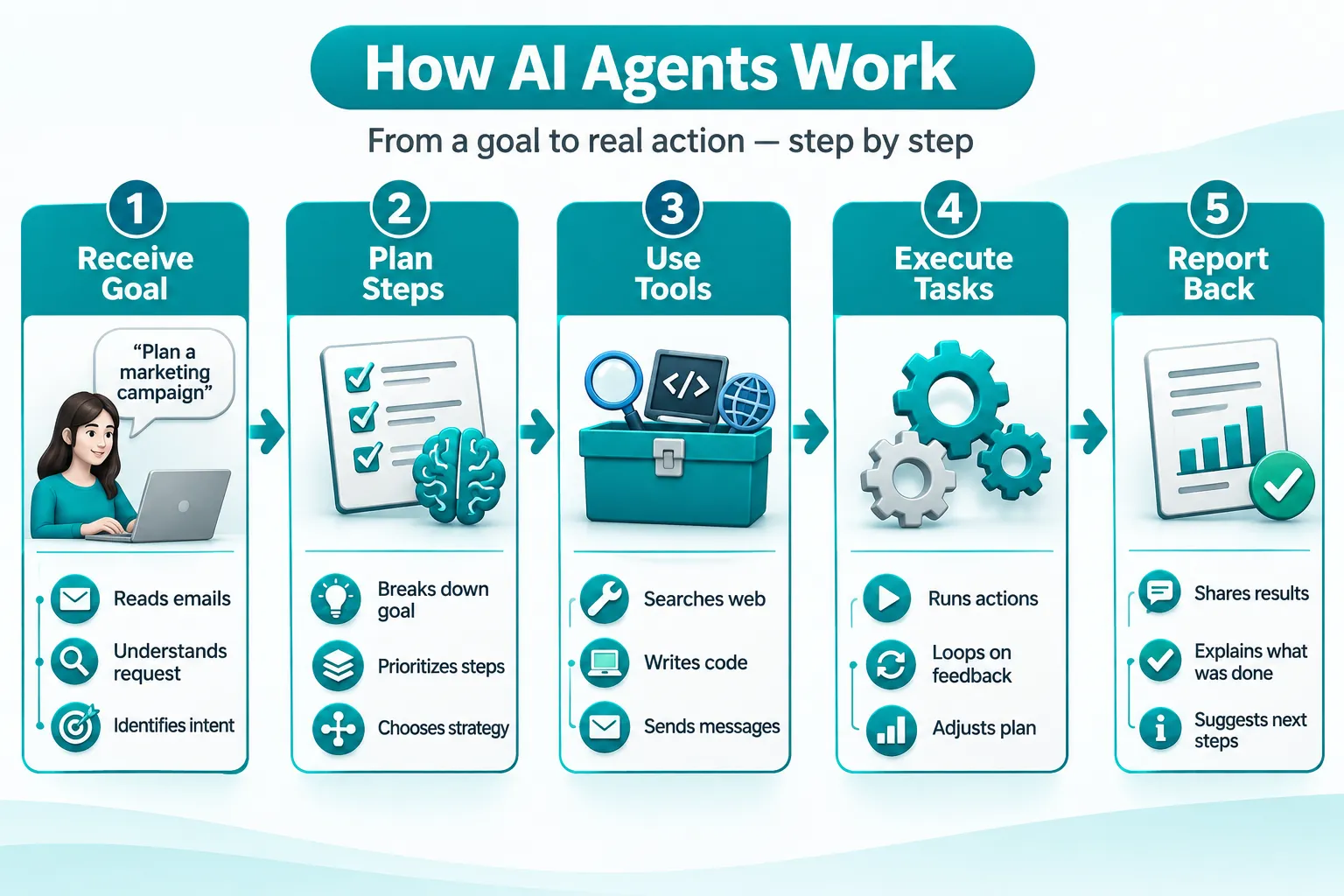
Before we dive in, a quick definition worth having: an AI agent differs from a basic automation tool in one important way. Automation follows fixed rules you set up in advance. An AI agent reasons through a goal, decides which steps to take, uses tools like search or code execution, and adapts when something doesn't work. Think of automation as a conveyor belt and an agent as a junior employee who figures out the route. For a deeper look at how workflow efficiency connects to these tools, that context is worth understanding before you pick a platform.
1. ChatGPT with GPT-6, The Generalist That Scaled Up
OpenAI expanded GPT-6 into mainstream ChatGPT on October 7, 2026. The upgrade introduced what OpenAI calls "Intelligent UI," which lets ChatGPT generate interactive tools and task-specific interfaces inside a conversation, not just text responses. GPT-6 Sol powers paid plans, while GPT-6 Luna handles Free and Go tiers.
For small business owners and marketers, this means ChatGPT can now build a usable project tracker or a lead qualification form mid-conversation and hand it back to you. It's not just smarter; it's more action-oriented. The agent mode handles research, drafting, data review, and presentation creation in sequence. If you're not technical, this is probably your most accessible starting point.
2. OpenAI Decisions API, Speed for Bounded Business Tasks
Launched generally on October 22, 2026, the Decisions API is built for near-real-time choices from text, images, and structured inputs. OpenAI reports it runs up to 10× faster than GPT-6 Luna through the standard Responses API, and supports up to 400 questions per single request.
This one is for developers and product teams. If you run an e-commerce platform and need to categorize thousands of support tickets, flag policy violations, or score leads automatically, the Decisions API fits that use case tightly. It supports native JSON output and regional inference residency in the US and EU, which matters when you're thinking about data compliance. Pair this with what you know about AI-powered content creation tools and you have a solid automation stack.
3. ChatGPT Work (Enterprise Deployment), Agents Inside Your Company Stack
Uber rolled out ChatGPT Work to more than 30,000 employees on October 22, 2026, expanding from an initial 1,000-person pilot. The agent connects to Google Drive, Gmail, Calendar, and Slack and can research topics, prepare meeting briefs, build presentations, and complete multi-step workflows.
This is the clearest proof that AI agents work at scale inside real organizations. For founders and CEOs, the takeaway is straightforward: agents plugged into your existing tools, email, calendar, documents, eliminate the switching cost that kills productivity. GPT-6.1 Sol is the default model in this deployment. If your team runs on Google Workspace, this setup deserves serious evaluation.
4. Codex, The Agent for Developers and Technical Founders
OpenAI's Codex agent handles code generation, debugging, and engineering workflows. Its integration into the OpenAI-ServiceNow partnership (expanded October 28, 2026) places it inside enterprise AI Workflow Factories for autonomous engineering tasks.
For technical startup founders, Codex is genuinely useful for writing boilerplate, reviewing pull requests, and generating test cases. It's not perfect, it can produce plausible-looking code that breaks on edge cases, so you still want a human review loop. But the speed gain on first drafts is real. Codex also feeds into multi-agent setups where one agent writes code and another reviews it. For context on how development fits into broader growth, see web development services.
5. Multi-Agent Systems, When One Agent Isn't Enough
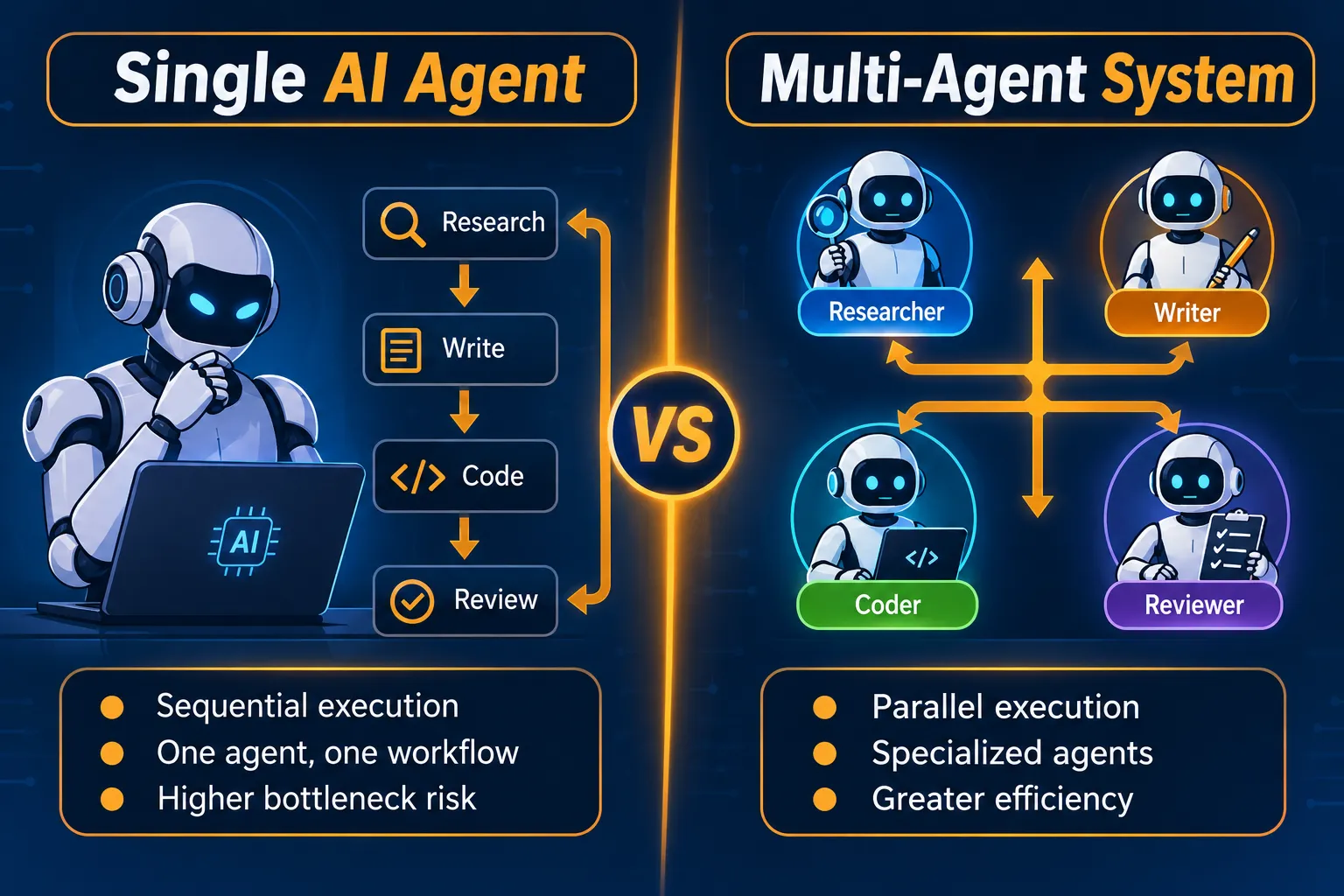
KPMG's Q3 2026 survey found that 25% of U.S. organizations were actively developing multi-agent systems, compared with just 6% in the two prior quarters combined [1]. The jump is striking. Organizations are moving from single-agent experiments to orchestrated systems where specialized agents handle different parts of a workflow.
A practical example: Third Moment Research ran 10,000 agents simultaneously for 36 to 48 hours using GPT-6 Astra, GPT-6.1 Sol, Codex, and a cybersecurity platform. That's a vendor case study, not an independent audit, but it illustrates the direction of travel. For marketing teams, a multi-agent setup might involve one agent researching keywords, another drafting content, and a third checking for SEO issues, all running in parallel.
6. AI Agents for Customer Service, Chatbots Have Grown Up
Modern customer service agents don't just answer FAQs. They pull order data, escalate tickets, send follow-up emails, and log conversations, all without human intervention. The difference between a 2022 chatbot and a 2026 agent is the ability to take action, not just respond.
For small business owners, this matters most when you're handling volume you can't staff for. A well-configured customer service agent can handle tier-1 queries 24/7, freeing your team for complex cases. Accuracy still varies by platform and training data, so testing against your actual use case before full deployment saves painful corrections later. Check out how chatbot integration fits into broader service strategy.
7. AI Agents for SEO and Content Marketing
AI agents are increasingly useful for the kind of repetitive, rule-based work that slows down SEO teams: crawling competitor pages, pulling keyword gaps, generating meta descriptions at scale, and monitoring ranking changes. Tools built on models like GPT-6 can now handle content briefs, internal linking suggestions, and even draft outlines from a single keyword input.
For digital marketing professionals, the ROI case is clearest in content operations. A single agent running nightly can flag pages that dropped in rankings and suggest updated content, work that used to require an analyst and a Monday morning meeting. For tools that complement this, the Semrush MCP Server is worth exploring, and understanding generative engine optimization helps you prepare content for AI-driven search results.
8. Free and Low-Cost AI Agents, What You Actually Get
Several capable agents are available free or at low cost in 2026. ChatGPT's Free tier uses GPT-6 Luna, which handles most everyday tasks well. Perplexity's agent mode is free for basic research. Many platforms offer trial periods before committing.
The honest limitation: free tiers typically cap usage, limit memory between sessions, and restrict access to external tools. For freelancers and students, free agents are genuinely useful for research, drafting, and simple task automation. For business-critical workflows, the paid plans justify their cost through higher limits and more reliable tool access [2].
9. AI Agents for E-commerce Operations
E-commerce operators face a specific set of repetitive tasks: product descriptions, inventory alerts, review responses, ad copy variations, and customer segmentation. Agents built for this context can handle all of these at volume, pulling from product data and customer behavior to personalize outputs.
The biggest win I see for online store owners is speed to market on new product listings. What used to take a copywriter a day can be drafted in minutes, reviewed in another few, and published before the competitor catches up. For strategy around this, see the e-commerce growth resources on DigitalPracer.
10. When AI Agents Fail, Honest Limitations to Know
AI agents fail for predictable reasons: vague goals, missing permissions, hallucinated steps, and tool access errors. An agent told to "improve our marketing" with no further context will produce generic output at best. One without access to your CRM will invent data it can't actually see.
The regulatory picture is also clarifying. UK regulators confirmed in November 2026 that existing competition, consumer, and data-protection obligations apply to AI agents, the agent's autonomy doesn't reduce your legal responsibility as the deploying organization [3]. The EU AI Act similarly covers agents under existing AI system definitions, with transparency obligations from August 2, 2026 onward. Plan your deployments with compliance in mind from the start.
11. How to Choose the Right Agent for Your Business
The right AI agent depends on three things: what task you're automating, what systems it needs to connect to, and how much technical setup you can handle. Non-technical users should start with ChatGPT or similar all-in-one platforms. Developers building products should evaluate the Decisions API or multi-agent frameworks. Marketing teams get the most from agents embedded in their existing content and analytics stack.
Cost is a real factor. Paid plans range from roughly $20/month for individual use to enterprise contracts that vary by usage volume [2]. KPMG found that only 12% of organizations consistently assess value against cost across their AI deployments, which means most teams are paying for capacity they don't fully measure [1]. Set a clear success metric before you buy.
12. AI Agents and the Future of Business Growth
The organizations moving fastest in 2026 aren't using one powerful agent. They're building ecosystems: specialized agents for research, execution, review, and reporting, coordinated by an orchestration layer. KPMG's survey found 55% of leaders cite productivity gains, 49% cite faster decision-making, and 38% cite improved customer experience as benefits from AI initiatives [1].
For small business owners and startup founders, the entry point is simpler than it sounds. Start with one task that costs you significant time each week. Automate that with an agent. Measure the result. Then expand. This approach mirrors how business growth strategies work in practice, incremental, measurable, compounding over time.
Conclusion
The best AI agents in 2026 aren't magic. They're task-specific tools that require clear goals, the right integrations, and a human who reviews output before it matters. The organizations seeing real results are the ones treating agents like team members, with defined roles, measurable outcomes, and regular check-ins.
Your next step: pick one repetitive task in your business, test a free-tier agent on it this week, and see whether the output saves you time. That single test will tell you more than any comparison chart.
References
- KPMG Q3 AI Pulse Survey. kpmg.com.
- Choosing an AI Model in 2026: Rankings, Prices and Cost Per Task. dev.to.
- AI Governance Weekly November 5, 2026. aigovernance.com.
.cg-wrap{font-family:system-ui,sans-serif;max-width:560px;margin:2rem auto;padding:1.2rem;border:1px solid #e2e8f0;border-radius:12px;background:#f8fafc}
.cg-title{font-size:1.1rem;font-weight:700;color:#1e293b;margin-bottom:.8rem;text-align:center}
.cg-label{font-size:.85rem;color:#475569;margin:.6rem 0 .25rem}
select.cg-sel{width:100%;padding:.45rem .6rem;border:1px solid #cbd5e1;border-radius:7px;font-size:.9rem;background:#fff;color:#1e293b}
.cg-btn{display:block;width:100%;margin-top:1rem;padding:.6rem;background:#0f766e;color:#fff;border:none;border-radius:8px;font-size:.95rem;font-weight:600;cursor:pointer}
.cg-btn:hover{background:#0d9488}
.cg-result{margin-top:1rem;padding:.8rem;background:#e0f2f1;border-radius:8px;font-size:.88rem;color:#134e4a;display:none;line-height:1.5}
.cg-result strong{color:#0f766e}
, Select ,
Content & SEO
Coding & Development
Business Operations
Customer Service
Research & Analysis
, Select ,
Non-technical
Moderate
Developer / Technical
const cgData={
content:{low:”ChatGPT (GPT-6 Luna/Sol), Start with ChatGPT’s agent mode. It handles briefs, outlines and meta descriptions without any setup. Upgrade to Plus for GPT-6 Sol on complex campaigns.”,mid:”ChatGPT + SEO integrations, Connect ChatGPT to your CMS via Zapier for automated content workflows. Pair with the Semrush MCP Server for keyword-driven drafts.”,high:”OpenAI Decisions API, Batch-process hundreds of content decisions (categorization, scoring, metadata) at up to 10× standard speed. Build into your content pipeline.”},
code:{low:”ChatGPT Agent Mode, Generate, explain and debug code in plain English. Good for no-code founders building prototypes.”,mid:”Codex (OpenAI), Automates boilerplate, reviews PRs and suggests tests. Works well inside VS Code and GitHub workflows.”,high:”Codex + Multi-Agent Orchestration, Run Codex as one node in a multi-agent system: one agent writes, another reviews, another deploys. See OpenAI’s Workflow Factory integrations.”},
ops:{low:”ChatGPT Work / Enterprise, Connects to Gmail, Drive, Calendar and Slack. Handles meeting briefs, reports and multi-step workflows without technical setup.”,mid:”ChatGPT Work + Zapier, Extend to your CRM and project tools with Zapier automations triggered by agent outputs.”,high:”Multi-Agent Pipelines, Orchestrate specialized agents for research, data analysis and reporting. 25% of enterprises are already building these (KPMG Q3 2026).”},
cx:{low:”ChatGPT-based Chatbots, Use a pre-built chatbot platform powered by GPT-6. Handles FAQs, order queries and escalations with minimal setup.”,mid:”Custom GPT Agent + CRM integration, Connect an agent to your helpdesk (Zendesk, Freshdesk) to pull order data and log tickets automatically.”,high:”OpenAI Decisions API, Classify and route thousands of support tickets in real time. Supports JSON output for direct CRM writes.”},
research:{low:”Perplexity Agent (Free), Great for quick research with cited sources. No setup needed. Upgrade for deeper, multi-step research runs.”,mid:”ChatGPT Agent Mode, Run multi-step research: search, summarize, compare and draft reports inside one conversation.”,high:”GPT-6 Astra / Multi-Agent Swarms, Run parallel research agents on large data sets. Third Moment Research ran 10,000 agents simultaneously on GPT-6 Astra for 36-48 hours.”}
};
function cgRecommend(){
const u=document.getElementById(‘cg-use’).value;
const t=document.getElementById(‘cg-tech’).value;
const r=document.getElementById(‘cg-result’);
if(!u||!t){r.style.display=’block’;r.innerHTML=’Please select both options above.’;return;}
r.style.display=’block’;
r.innerHTML=cgData[u][t]||’No match found. Try a different combination.’;
}